
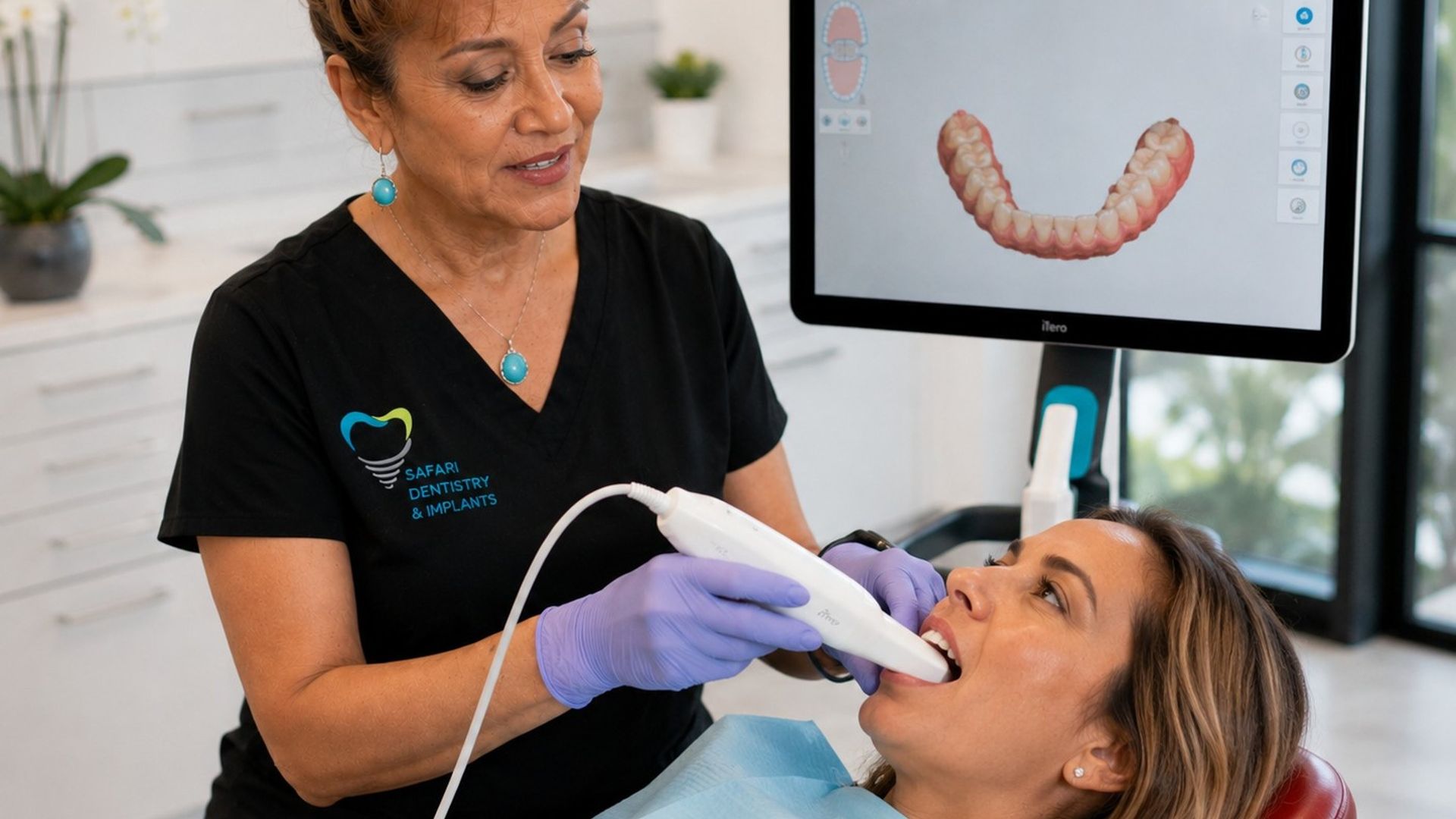

Porcelain veneers in Huntington Beach at Safari Dentistry and Implants are designed on an intraoral scan, shown to you on screen, and then placed over your own teeth as a trial smile, so the shape and shade are approved before any enamel is touched. A board-certified periodontist works in the same office at Goldenwest and Heil and checks the gum line first, because that is where every veneer ends and where most veneer problems start.
What are porcelain veneers?
A porcelain veneer is a thin ceramic shell, about half a millimeter thick, bonded to the front of a tooth to change its color, shape, length or spacing. At Safari Dentistry and Implants veneers for Huntington Beach patients are designed on an intraoral scan, previewed in your own mouth as a trial smile, and bonded only after you approve the shape and shade. The periodontist in the office checks the gums first, because the edge of every veneer sits at the gum line.
- Porcelain veneers: lab-made ceramic, two visits, resist staining, last 10 to 15 years.
- Composite veneers: resin sculpted directly on the tooth in one visit; lower cost, easier to repair, last 4 to 8 years.
- Minimal-prep veneers: for teeth that are small or set back, where little or no enamel needs to be removed.
- Single veneer: one dark or chipped front tooth matched to its neighbors, the hardest match in dentistry and planned with extra shade photographs.
How the veneer process works at Safari
Porcelain veneers take two main visits about two weeks apart, after a consultation where the smile is designed. Huntington Beach patients see the proposed result twice before anything permanent happens: once on screen, and once as a temporary mock-up placed over their own teeth.
- Consultation and scan. Photographs, an intraoral scan, a bite check and a gum exam by the periodontist. You get the plan and the fee per tooth in writing.
- Design and trial smile. The new shape is designed digitally, then placed over your teeth in temporary material so you can see and feel it.
- Preparation. A thin layer of enamel, usually 0.3 to 0.7 mm, is shaped under local anesthetic, a final scan is taken, and temporary veneers are fitted.
- Bonding. The ceramic veneers are tried in, checked for shade in daylight, and bonded. A night guard is made if you grind.
Why the gums are checked before veneers
A veneer ends at the gum line. If the gum is inflamed it bleeds during bonding and weakens the seal, and if it later recedes, the edge of the veneer shows. A periodontist treats inflammation and recession before the veneers are made and can even out a gum line that makes teeth look different lengths. Most cosmetic offices refer that out; here it is the same building.
Veneers, bonding or crowns: which does the tooth need?
Veneers suit front teeth that are healthy but the wrong color, shape or length. Bonding suits a single small chip or gap and costs less. A crown suits a tooth that is cracked, heavily filled or root canal treated, because it needs full coverage rather than a front shell. Huntington Beach patients are told which of the three each tooth needs, and a plan often mixes them.
- Porcelain veneer
- 2 visits, 10 to 15 years, resists stain
- Composite veneer
- 1 visit, 4 to 8 years, repairable
- Bonding
- 1 visit, 3 to 7 years, single chips and gaps
- Ceramic crown
- 2 visits, 10 to 15 years, for broken or filled teeth
- Enamel removed
- 0.3 to 0.7 mm for most veneers
Who is not a good candidate for veneers?
Veneers are not the right choice on teeth with untreated decay or gum disease, on teeth with very little enamel left, or for heavy grinders who will not wear a night guard. Crowded teeth are usually better straightened first with Invisalign, which means less enamel removed and sometimes fewer veneers. You will be told this at the consultation rather than sold a full set.
What do veneers cost in Huntington Beach?
Veneers are priced per tooth, and the total depends on how many teeth show when you smile, usually four to ten. The fee is written down at the consultation and includes the design, the trial smile, the temporaries and the follow-up visit. Veneers are elective and not covered by dental insurance, so monthly payment plans are offered, and any crown or gum treatment in the same plan is billed to your PPO or HMO separately.
What to bring to your first veneer visit
- Photos of a smile you like, and one of your own smile from a few years ago.
- Any veneer quote or plan from another office, to compare tooth by tooth.
- A note of whether you grind or clench; it decides the ceramic and whether a night guard is part of the plan.
- Your insurance card; veneers are not covered, but a crown or gum treatment in the same plan often is.
Veneers as part of a smile plan
Veneers are rarely the whole plan. Natural teeth are whitened first so the ceramic is matched to the brighter shade, crowded teeth are often straightened with Invisalign so less enamel is removed, and the periodontist evens the gum line where teeth look different lengths. See cosmetic dentistry for whitening, bonding and the rest of the plan.