
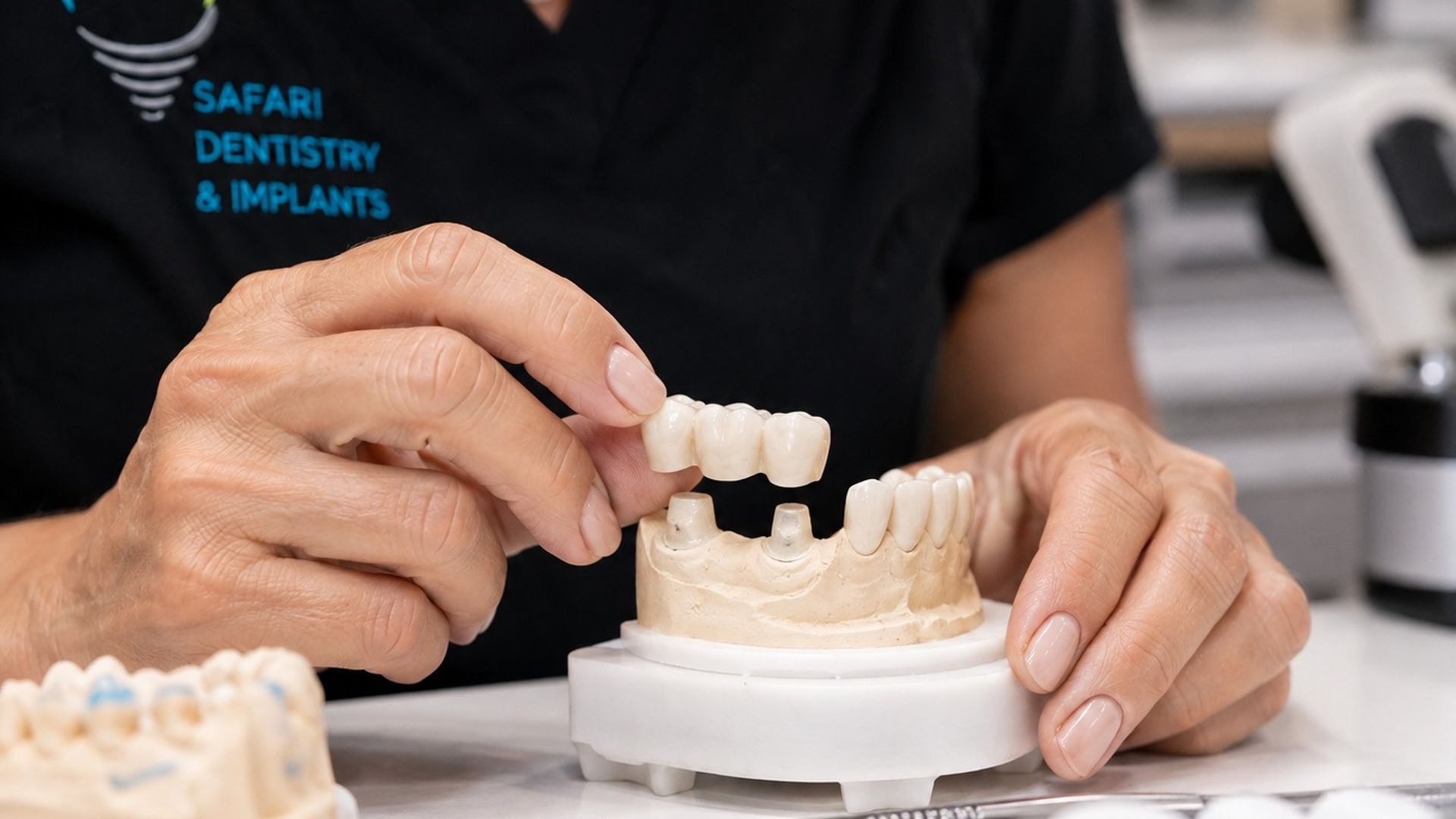

Gum grafting in Huntington Beach covers exposed roots and thickens thin gum tissue; crown lengthening removes a small amount of gum and bone to expose more tooth. Both procedures at Safari Dentistry and Implants are done by a board-certified periodontist, the specialist whose training is the gum and bone, and both take about an hour in the Huntington Beach office with local anesthetic.
What is gum grafting and when is it needed?
Gum grafting takes a small piece of tissue, from the roof of the mouth or from a donor source, and places it over a receded root or a thin area of gum so that healthy tissue regrows. It is needed when recession exposes the root, causing sensitivity, decay on the root surface, a notch at the gumline, or a tooth that looks too long.
- Connective tissue graft: tissue from under the palate, placed over the root. The most common and most predictable for root coverage.
- Free gingival graft: surface tissue from the palate, used to thicken gum that is too thin, often around lower front teeth or implants.
- Donor tissue graft (allograft): processed donor tissue, no second surgical site, used for multiple teeth in one visit.
- Pinhole technique: the existing gum is loosened through a small hole and moved over the root, no graft harvested; suitable for mild recession.
What is crown lengthening?
Crown lengthening reshapes the gum, and if necessary the bone underneath, to expose more of the tooth. It is done for two reasons: to give a dentist enough tooth to hold a crown or filling when a tooth is broken or decayed near the gumline (functional crown lengthening), or to reduce a gummy smile by revealing more of the front teeth (esthetic crown lengthening).
- Functional crown lengthening
- One tooth, done before a crown; the crown is placed 4 to 6 weeks later
- Esthetic crown lengthening
- Usually the six to ten upper front teeth; final result visible at 6 to 8 weeks
- Visit length
- 45 to 90 minutes under local anesthetic, sedation available
- Recovery
- Mild soreness 3 to 5 days; stitches out at 1 to 2 weeks
Does gum grafting hurt and how long does it take to heal?
The graft is placed under local anesthetic, so the procedure is not painful; the palate donor site is the sore spot afterward and feels like a pizza burn for about a week. The grafted area heals over 2 to 3 weeks, with full color blending by 6 to 8 weeks, and you eat soft foods and avoid brushing the site until the periodontist clears it.
- Consultation. Recession is measured, the cause is identified (brushing habits, grinding, thin tissue, orthodontics), and the graft type is chosen.
- Procedure. About an hour. A protective stent is provided for the palate if tissue was taken there.
- First week. Soft diet, no brushing at the site, prescription rinse.
- Check at 2 weeks. Stitches removed if needed.
- Final review at 6 to 8 weeks. Root coverage is assessed.
What do gum grafting and crown lengthening cost in Huntington Beach?
Both are quoted per tooth or per site in writing after the consultation, and both are covered in part by many PPO plans when done for a medical reason such as root exposure or a tooth that needs a crown. Esthetic crown lengthening is usually not covered, and payment plans are available for any balance.
Gum treatment for patients from Westminster, Fountain Valley and Seal Beach
The periodontist who does the graft is the same one who checks it at 2 and 8 weeks, at 16511 Goldenwest St, Unit 101. If a crown follows a crown lengthening, the general dentistry team in the same office makes it.