
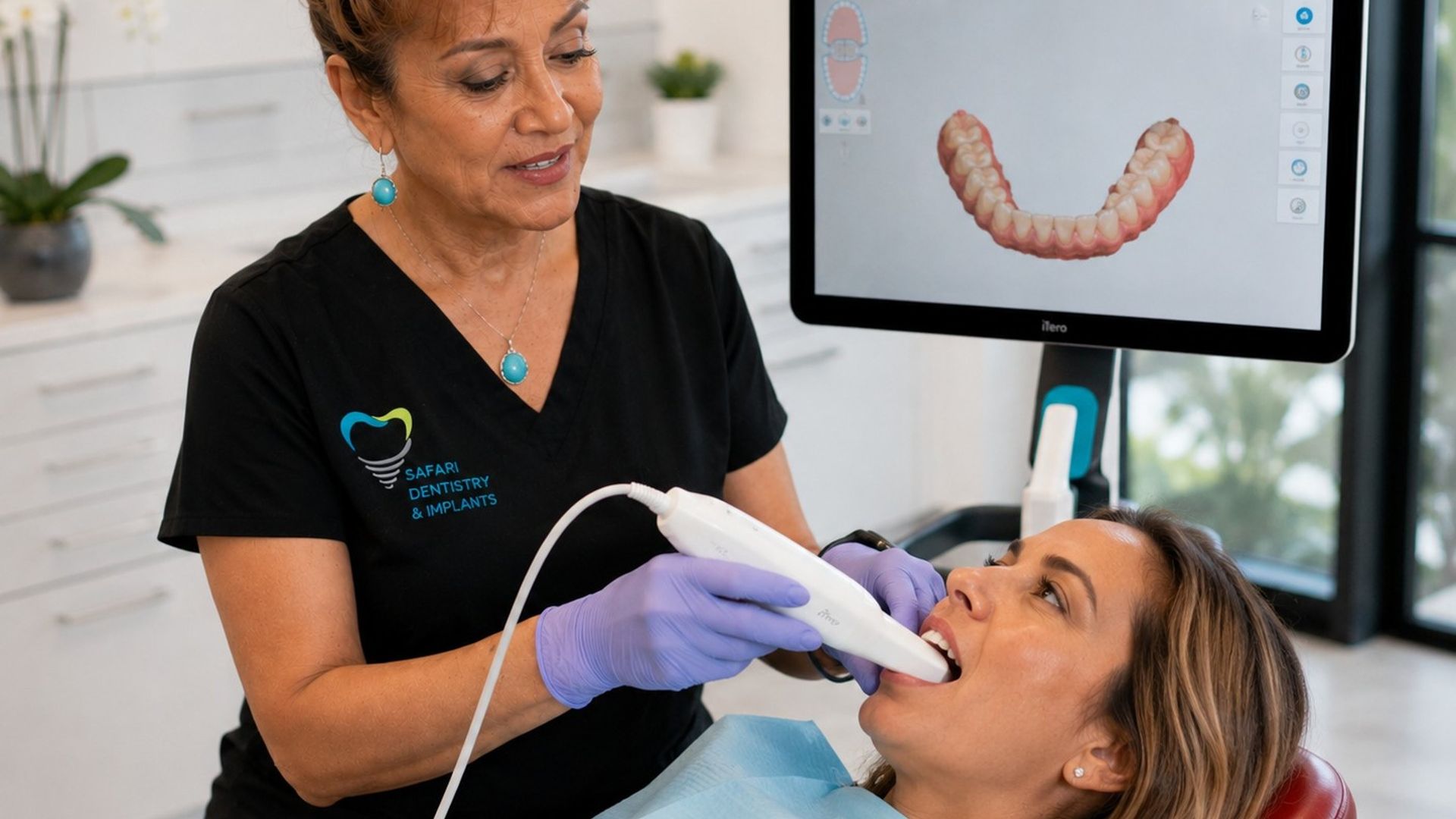

A periodontist is a dentist with three additional years of specialty training in the gums and bone that hold teeth, and in placing dental implants. At Safari Dentistry and Implants in Huntington Beach, the board-certified periodontist treats gum disease at every stage, from deep cleaning to gum surgery and grafting, and you can see the Huntington Beach periodontist directly without a referral from another dentist.
What does a periodontist treat?
A periodontist treats gingivitis and periodontitis (gum disease), gum recession, bone loss around teeth, and the placement and maintenance of dental implants. The specialty also covers gum grafting, crown lengthening, and the treatment of infections around implants.
- Gum disease treatment: scaling and root planing (deep cleaning), laser therapy, antibiotic therapy, pocket reduction surgery.
- Regeneration: bone and tissue grafts to rebuild what periodontitis destroyed.
- Gum grafting: covering exposed roots and thickening thin gums. See gum grafting and crown lengthening.
- Dental implants: placement, bone grafting and long-term care. See dental implants.
- Peri-implantitis: infection around an existing implant, including implants placed elsewhere.
What are the signs of periodontal disease?
The early signs are gums that bleed on brushing, redness, swelling and persistent bad breath. As it advances, the gums pull away from the teeth, pockets form and deepen, teeth become sensitive at the roots, and eventually loosen as the bone supporting them is lost.
- Gingivitis
- Bleeding, red gums, no bone loss; reversible with cleaning and home care
- Mild periodontitis
- Pockets 4 to 5 mm, early bone loss; deep cleaning
- Moderate periodontitis
- Pockets 5 to 7 mm, visible recession; deep cleaning plus laser or surgery
- Advanced periodontitis
- Pockets over 7 mm, loose teeth; surgery, regeneration, or extraction and implants
Does deep cleaning fix periodontitis?
Scaling and root planing removes the bacteria and hardened tartar below the gumline and is the first-line treatment for mild to moderate periodontitis; in most patients it shrinks pockets and stops the bleeding within 4 to 6 weeks. It does not regrow lost bone, and pockets deeper than about 6 millimeters usually need laser therapy or pocket reduction surgery to be cleaned fully.
Deep cleaning is done with local anesthetic, one or two quadrants per visit, and is followed by periodontal maintenance cleanings every 3 to 4 months instead of every 6. The maintenance visits are what keep the disease from returning.
How is gum disease treated at Safari?
- Periodontal exam. Pocket measurements at six points per tooth, digital X-rays, and a review of your medical history (diabetes, smoking and some medications change the plan).
- Deep cleaning. Scaling and root planing under local anesthetic, with oral sedation available for anxious patients.
- Re-evaluation at 6 weeks. Pockets are re-measured. Most patients are done and move to maintenance.
- Laser or surgery if needed. Laser periodontal therapy for pockets that did not resolve; pocket reduction or regenerative surgery for advanced sites.
- Maintenance every 3 to 4 months. In the same office, with the same team who did the treatment.
How much does periodontal treatment cost and is it covered?
Deep cleaning is priced per quadrant and is covered by most PPO and HMO dental plans and by Medi-Cal Dental for adults, typically at 50 to 80 percent. Laser therapy and gum surgery are quoted in writing after the exam, and payment plans are available for the portion insurance does not cover.
Do you need a referral to see a periodontist in California?
No. California does not require a referral to see a periodontist, and most PPO plans and Medi-Cal Dental let you book a specialist directly. Some HMO plans require an authorization from your assigned dentist, and the front desk can check that before your visit.
Periodontal care for Westminster, Fountain Valley and Garden Grove patients
Because the periodontist and the general dentistry team work in one office at 16511 Goldenwest St, Unit 101, your deep cleaning, maintenance visits, fillings and crowns all happen at one address with one chart.