
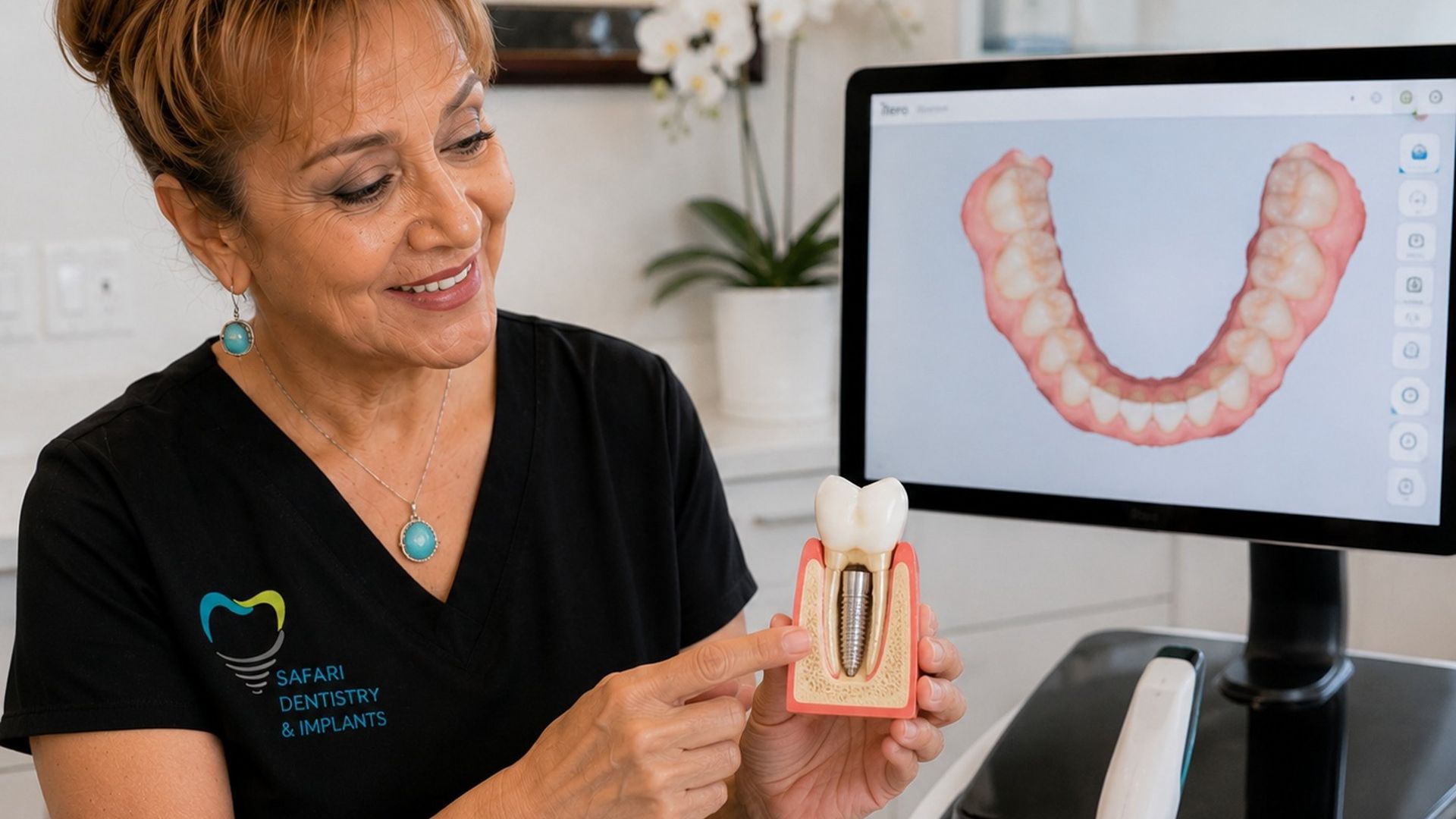

Dental implants Huntington Beach patients get at Safari Dentistry and Implants are placed by a board-certified periodontist: a titanium post replaces the missing tooth root and a crown on top looks and works like a natural tooth. Because one Huntington Beach office plans the dental implant on a 3D CT scan, places it and restores it, you get one plan, one written price and one team from scan to crown.
What are dental implants and how do they work?
A dental implant has three parts: the implant post that sits in the bone, an abutment that connects to it, and the crown you see. The post is titanium, the same metal used in hip and knee replacements, and bone grows onto it over 3 to 6 months in a process called osseointegration. Once it is solid, the crown is attached and the tooth is used normally.
Implants can replace one tooth, several teeth with an implant bridge, or every tooth in an arch with All-on-4 full-arch implants. Unlike a bridge, an implant does not require grinding down the teeth beside the gap, and unlike a denture it does not rest on the gums.
Who is a candidate for dental implants in Huntington Beach?
Most healthy adults with a missing tooth are candidates, including patients in their 70s and 80s. The requirements are enough bone to hold the post, healthy gums, and general health that allows minor surgery. Age alone is not a reason to say no.
- Bone loss
- Usually fixable with a bone graft or sinus lift done here before or with the implant
- Gum disease
- Treated first by the periodontist so the implant sits in healthy tissue
- Smoking
- Raises failure risk; we ask you to stop for 2 weeks before and 8 weeks after
- Diabetes
- Fine when controlled; we coordinate with your physician on A1C
- Blood thinners, bisphosphonates
- Reviewed case by case with your prescribing doctor
- Missing teeth for years
- Common; the CT scan shows how much bone remains and what grafting is needed
What does a dental implant cost in Huntington Beach?
A single dental implant with the abutment and crown is quoted in writing after your CT scan, because the total depends on whether a bone graft or sinus lift is needed, the type of crown, and what your insurance covers. You leave the consultation with the full number and a payment plan option, not an estimate that grows later.
Safari Dentistry and Implants accepts most PPO and HMO plans, Medi-Cal Dental and private pay. Many PPO plans cover part of the crown or the extraction even when they exclude the implant post; the front desk checks your benefits before the plan is written. In-house financing spreads the balance over monthly payments.
Your written implant plan lists:
- The implant, abutment and crown as separate line items
- Any bone graft or sinus lift, with its own price
- Your insurance estimate and what is left to pay
- Monthly payment options and the number of visits
Cannot afford dental implants right now? Ask about a staged plan: extraction and graft now, implant when the bone has healed, crown after that. Each stage is priced separately and billed only when it happens.
How the dental implant process works at Safari
- Consultation and 3D CT scan. The scan measures bone height, width and nerve position. The periodontist shows you the images and explains the options on screen.
- Preparation, if needed. Extraction, bone grafting or a sinus lift, done in this office with local anesthetic and oral sedation available. Healing takes 3 to 6 months.
- Implant placement. A 45 to 90 minute visit. Most patients return to work the next day and manage discomfort with over-the-counter medication.
- Healing. 3 to 6 months while bone bonds to the post. A temporary tooth is provided for front teeth.
- Abutment and crown. An intraoral scan replaces goopy impressions; the crown is fitted and adjusted so your bite is even.
How long do dental implants last?
The implant post can last a lifetime when the surrounding bone and gum stay healthy; long-term studies report success rates above 95 percent at 10 years. The crown on top typically lasts 10 to 15 years before wear calls for a replacement.
The main threat to an implant is peri-implantitis, gum infection around the post. Because a periodontist is the specialist in exactly that tissue, your implant is placed and maintained by the person trained to prevent it. Cleanings every 6 months and daily flossing around the implant keep it healthy.
What are the downsides and alternatives to dental implants?
The downsides are time, cost and minor surgery: an implant takes 3 to 9 months start to finish and costs more up front than a bridge or partial denture. The alternatives are a fixed bridge, a removable partial, or a full denture, each of which Safari also provides.
- Fixed bridge: faster and cheaper, but the neighboring teeth are ground down and the bone under the gap keeps shrinking. See crowns, bridges and dentures.
- Removable partial denture: lowest cost, comes out at night, can loosen over time.
- Implant-supported denture or All-on-4: for patients missing most teeth, 4 to 6 implants hold a full arch that does not come out. See All-on-4 dental implants.
Dental implants for Westminster, Fountain Valley and Garden Grove patients
The office at 16511 Goldenwest St, Unit 101 is 10 to 20 minutes from Westminster, Fountain Valley, Garden Grove, Seal Beach and Midway City, with free parking. Everything, including the CT scan, grafting, placement and crown, happens at this one address, so there are no referrals across town between steps.