
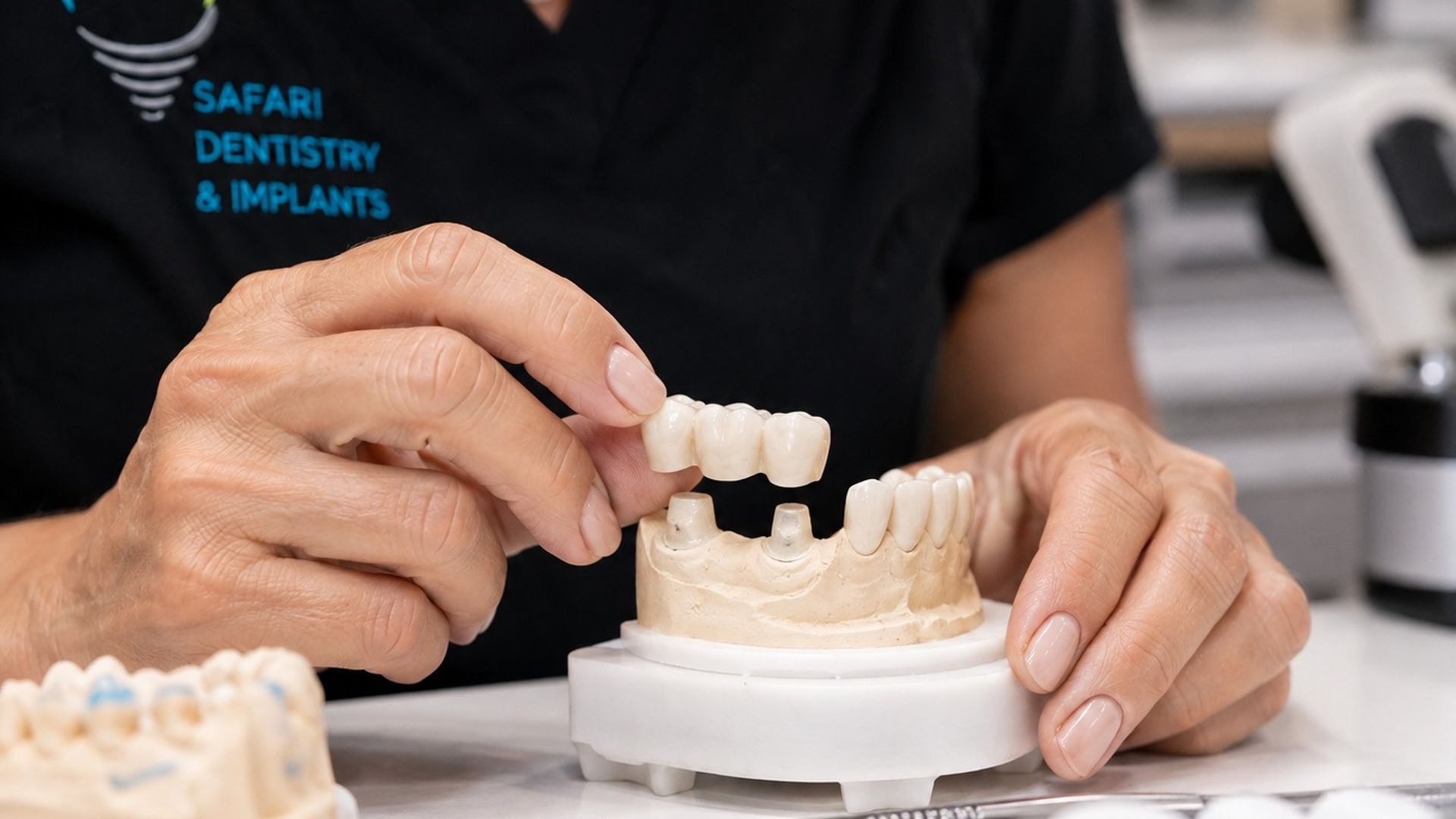

A dental bridge in Huntington Beach at Safari Dentistry and Implants replaces one to three missing teeth in two visits, using ceramic teeth joined to crowns on either side of the gap. The bridge is made from an intraoral scan instead of impression trays, and because a board-certified periodontist places implants in the same office at Goldenwest and Heil, the bridge and the implant alternative are examined on the same X-ray and priced on the same estimate.
What is a dental bridge?
A dental bridge replaces one to three missing teeth with ceramic teeth that are joined to crowns on the teeth either side of the gap. It is fixed in place, not removable, and is made in two visits about two weeks apart. At Safari Dentistry and Implants bridges for Huntington Beach patients are made from an intraoral scan rather than impression trays, and the periodontist checks that the anchor teeth have enough bone and healthy gum to carry the load.
- Traditional bridge: a crown on each side of the gap with the replacement tooth between them; the most common and the strongest.
- Cantilever bridge: anchored on one side only, used where there is a tooth on just one side of the gap and the bite is light.
- Bonded (Maryland) bridge: a replacement tooth with wings bonded to the back of the neighbors; little or no drilling, mainly for front teeth.
- Implant-supported bridge: two implants carrying three or more teeth, for longer gaps; see dental implants.
Dental bridge or implant: which is better?
A bridge is faster and costs less up front, and insurance is more likely to help pay for it. An implant takes months and costs more, but it leaves the neighboring teeth untouched and keeps the bone in the gap. For Huntington Beach patients the deciding factor is usually the teeth beside the gap: if they already need crowns, a bridge does two jobs at once; if they are untouched, an implant spares them.
- Bridge
- 2 visits over 2 to 3 weeks, lasts 10 to 15 years
- Implant and crown
- 3 to 9 months, lasts 20+ years, needs enough bone
- Partial denture
- 2 to 4 visits, lowest cost, removable
- Neighboring teeth
- Crowned for a bridge, untouched for an implant
- Bone in the gap
- Shrinks slowly under a bridge, preserved by an implant
Why a periodontist looks at the anchor teeth
A bridge is only as good as the teeth holding it. If those teeth have bone loss or gum disease, the bridge loosens with them, which is the usual reason a bridge fails early. The periodontist measures the bone and gum around each anchor tooth first, treats any disease, and says plainly when the anchors are too weak and an implant or a partial is the safer plan.
How a bridge is made at Safari
A bridge takes two visits about two weeks apart. Huntington Beach patients leave the first visit with a temporary bridge, so there is no gap while the final one is made.
- Exam, X-ray and plan. The anchor teeth, gums and bite are checked, a bridge and an implant are priced side by side, and the fee is written down.
- Preparation and scan. The anchor teeth are shaped under local anesthetic, an intraoral scan is taken, the shade is matched, and a temporary bridge is fitted.
- Fitting. The final zirconia or ceramic bridge is tried in, the bite is adjusted and it is cemented.
- Follow-up. A short check after a week or two, and a lesson on cleaning under the bridge with a floss threader or water flosser.
Replacing an old or failing bridge
Bridges last 10 to 15 years, and many Huntington Beach patients come in with one that has come loose, chipped, or has decay under a crown. If the anchor teeth are still sound, a new bridge is made. If one of them cannot be saved, the periodontist can remove it, graft the socket, and plan implants to carry the new teeth, all in this office. See crowns, bridges and dentures for the other options.
What does a dental bridge cost in Huntington Beach?
A bridge is priced per unit: each crown and each replacement tooth counts as one, so a three-unit bridge replaces one tooth. The fee is written down at the consultation, next to the fee for an implant, so the two can be compared. Most PPO and HMO plans pay part of a bridge, often about half; Medi-Cal Dental coverage for fixed bridges is limited, so the front desk checks it before the plan is priced. Monthly payment plans are available.
What to bring to your first bridge visit
- Any recent X-rays, or the old bridge if it has come out.
- Your insurance card or Medi-Cal Dental member number; benefits and any missing-tooth clause are checked before the plan is priced.
- The date the tooth was lost or is due to be removed; some plans ask for it.
- Any implant quote you already have, so a bridge and an implant can be compared line by line.
Bridges, crowns, dentures and implants in one office
A bridge is one of four ways to replace missing teeth here. A single dental implant spares the neighboring teeth, a partial or full denture covers longer gaps at the lowest cost, and an implant-supported bridge carries three or more teeth on two implants. See crowns and dentures for those options; all of them are quoted in writing after your insurance is checked.