
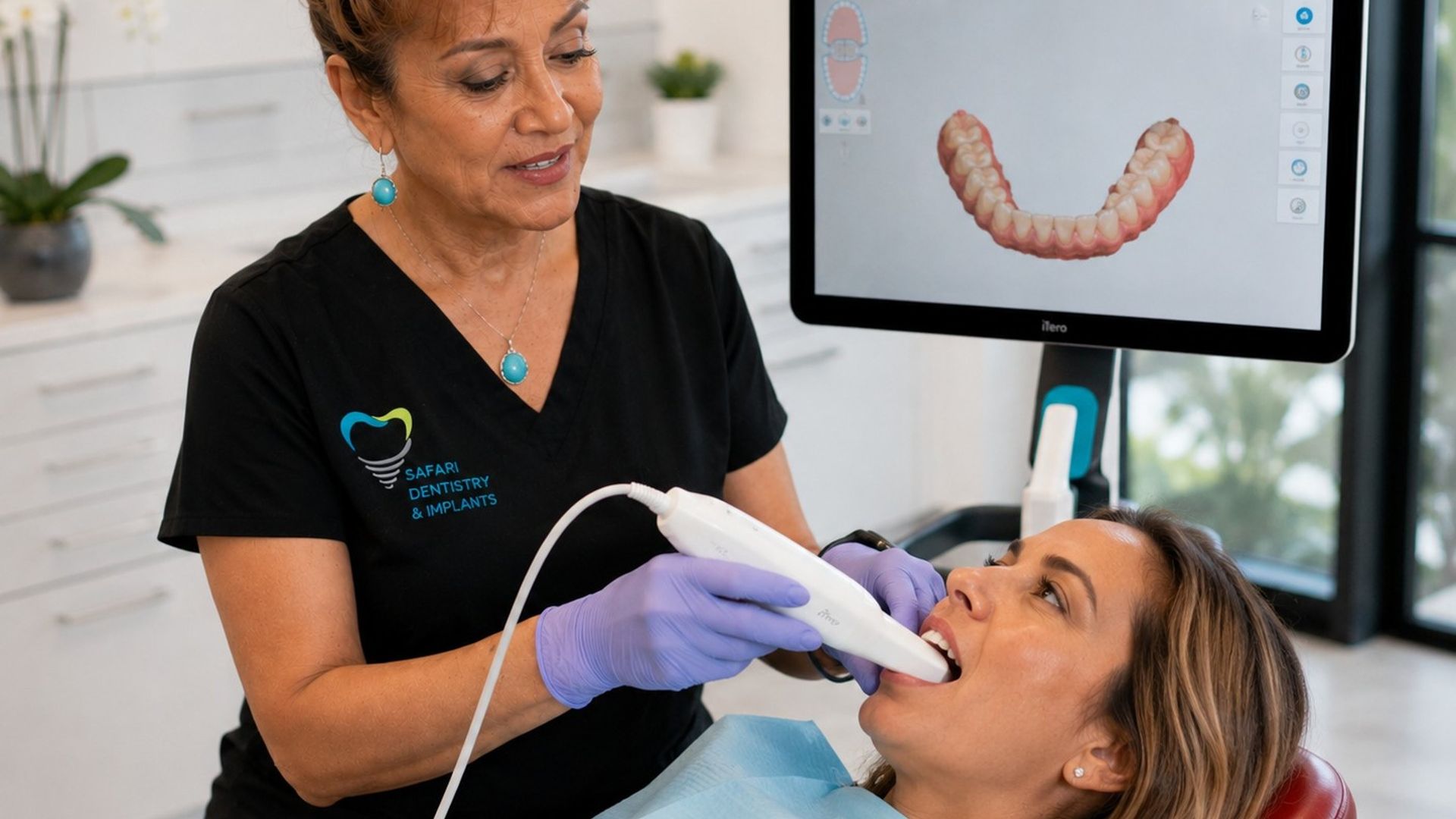

Invisalign in Huntington Beach at Safari Dentistry and Implants starts with something most aligner providers skip: a periodontist examines the gums and bone before the scan, because aligners move teeth through bone and moving them through bone that is already receding makes the loss worse. Once the gums are cleared, the aligner series is designed on an in-office intraoral scan, you see the projected result on screen, and the fee is written down with retainers included.
How does Invisalign work?
Invisalign moves teeth with a series of clear, removable plastic aligners, each worn about 22 hours a day for one to two weeks before you switch to the next. The series is planned from a digital scan, so the finished position is shown before the first aligner is made. Mild crowding or spacing usually takes 6 to 12 months; moderate cases 12 to 18 months.
- Consultation and scan. An intraoral scan, photographs, and a gum and bone check by the periodontist.
- Digital plan. You review the simulated movement and the end result, and get the fee in writing.
- Aligners. Small tooth-colored attachments are bonded where needed and you receive the first sets.
- Check-ins. A short visit every 6 to 10 weeks, Monday to Thursday; aligner changes happen at home.
- Retainers. After the last aligner, retainers hold the result. Skipping them is how teeth drift back.
Invisalign or braces?
For most adults and teens with crowding, spacing or a mild bite problem, clear aligners do the same job as braces without wires or food restrictions, and they come out for brushing and flossing. Braces still win for some severe bite corrections and for patients who will not wear an aligner 22 hours a day. The scan shows which category you are in, and you are told plainly.
- Mild crowding or spacing
- 6 to 9 months, about 12 to 20 aligners
- Moderate cases
- 12 to 18 months
- Wear time
- 20 to 22 hours a day
- Check-ins
- Every 6 to 10 weeks
- After treatment
- Retainers nightly, indefinitely
Why gum health decides whether you can start
Aligners move teeth through bone, and if the bone is being lost to gum disease, moving the teeth accelerates it. Mail-order aligner companies never check this, and many general offices check it only lightly. At Safari the periodontist examines the gums and bone at the first visit, treats any disease first, and clears you for aligners when it is safe. Adults who were told elsewhere that their gums rule out straightening are welcome to be re-examined.
Invisalign for adults who had braces years ago
A large share of adults asking about Invisalign wore braces as teenagers and lost the retainer. Teeth that drifted over ten or twenty years usually need a short course, 6 to 9 months, followed by a night-time retainer. The periodontist checks that the gums have not receded in the meantime and grafts the gum first where they have.
Invisalign for teens
Teenagers are good candidates once the adult teeth are in, and aligners fit around sports, band and photos better than braces. Compliance is the main risk: the aligner only works while it is in. The office reviews wear time at each check-in and can see from the fit whether the aligners are being worn.
What does Invisalign cost in Huntington Beach?
The fee depends on how many aligners the plan needs, and it is written down at the consultation with attachments, check-ins and the final retainers included, so nothing is added later. Many PPO plans have an orthodontic benefit that pays part of it, some HMO plans cover a share for children, and Medi-Cal Dental covers orthodontics only in specific medically necessary cases. Monthly payment plans are available.
What to bring to your first Invisalign visit
- Old retainers or records from previous braces, if you have them.
- Your insurance card; the front desk checks for an orthodontic benefit before the plan is priced.
- A sense of your timeline, for a wedding or a move, so the plan can be sequenced around it.
- Questions about wear time and eating; the answers decide whether aligners suit you.
Invisalign as part of a smile plan
Straightening first often means fewer veneers later, because straight teeth need less covering. Many patients do a short aligner course, then whitening, then bonding on the one or two teeth that still need shape. The periodontist evens the gum line where needed. See cosmetic dentistry for the rest of the plan.